Thursday, August 28, 2008

Hack Week III: Tomboy Joins The Dark Side

Tomboy on Windows Where It Belongs

As you all know, my job here at Novell is to migrate all worthwhile desktop Linux applications off of that ridiculous platform and onto Windows so that we can do away with this nasty open source stuff. Unfortunately I haven't yet gotten the paper work to close up my code for the latest victim of this effort, so for now dirty open source hippies can get it here:

http://svn.gnome.org/svn/tomboy/branches/tomboy-portable2/

Somebody even impersonated me and posted instructions and current limitations on our mailing list (soon to be replaced with a 1-900 number offering support for a reasonable fee).

And here's an image of what it looks like. Windows has a really awesome feature where you can press your "Print Screen" button, and then you dig around in the menus to find the excellent Microsoft Paint application, at which point you recall that you can produce a "screen shot" by "pasting". Then you save in one of a myriad of excellent file formats, and you have an image of what you were doing on your computer! You can then share it with your friends like so:


What do you think? Excited to end the Linux charade and switch to a solid and hip platform like Vista? Woo!

I feel very silly today.

Utah Open Source Conference

I was fortunate enough to get to join my friends and coworkers in Provo for this Hack Week. I normally work from my home office, so I'm having a blast seeing everybody. Today we're working at Salt Lake Community College as part of the Utah Open Source Conference. I'm actually talking with my buddy Brian Merrell about the efforts of the Mono a11y team (you know, my actual job). It should be fun, we've got some neat slides and we are both cool people so I don't really see what could go wrong. The UTOSC team has done a ridiculously awesome job setting up this conference, so I'm really excited to see everything come to fruition. We had a sweet speaker dinner last night but moron that I am I forgot my camera so you just have to take my word for it!

This Tomboy stuff still needs a bit of work so off I go. Hopefully having Tomboy run on more platforms will help us attract more users and developers. I know it's a popular request so I'm pretty serious about getting it supported in trunk. Later guys!

Monday, August 18, 2008

Minor releases: Tomboy 0.11.2 and Tasque 0.1.7

Hi everybody! Today I made two minor software releases:

Tomboy 0.11.2 features build fixes, a fixed crasher or two, and improved HTML Export functionality.

Tasque 0.1.7 makes translations actually work, and adds cool tooltips to tasks that show associated notes.

Due to time constraints, these releases do not have any silly names attached to them. I'll make up for this next time. ;-)

Monday, August 4, 2008

Tomboy 0.11.1 Released

I finally got some time this weekend to take care of some irritating Tomboy bugs, so today I present to you Tomboy 0.11.1, "A PhD in Horribleness":
  • New tray icon code using GtkStatusIcon (kill libegg, #349265, Stefan Cosma).
  • Fix crashers: #544406, #460642, #544996, #523035
  • Fix bugzilla addin to accept bug IDs of one or more digits (#533024).
  • Fix behavior when start note is recreated (#508982, Jon Lund Steffensen)
  • Include .mdb files during install. Allow --debug, --trace, and --profile options when running Tomboy.
  • Translation updates: ar, bg, ca, de, es, et, fr, gl, he, nb, nl, oc, pt_BR, sk, sv, th, vi, zh_CN
Major things left to do before 0.12.0 is released: Finish port to GtkPrint, fix major outstanding bugs in synchronization, and, if there's time, do some work on startup performance. All help is welcome, especially on the GtkPrint stuff! :-)

Monday, July 14, 2008

GHOP Awards Ceremony

I just finished a great weekend in the San Francisco Bay Area, thanks largely to Google and their Highly-Open Participation Contest (GHOP). As you may already know, Google worked with several open source projects to run a contest for high school-aged students to complete tasks ranging from translation and documentation to coding and other bug fixes. Vincent Untz, Andre Klapper, and Behdad Esfahbod, Lucas Rocha, and Christian Kellner ran things from the GNOME end, and did a great job. Unfortunately the awards ceremony for GHOP grand prize winners was scheduled for this past Friday, and they were busy at GUADEC. Since I had been involved in GHOP as a mentor, I volunteered to represent GNOME at the ceremony. Later, I found out that the Mono project was unable to send a representative as well. Their side was largely administered by Miguel de Icaza and Michael Hutchinson, and Michael asked me to represent them since I was already going to be there. So although I was probably the least-involved mentor at the ceremony, I was also the only one with two students. :-P

GNOME's Grand Prize Winner: Patrick Hulin

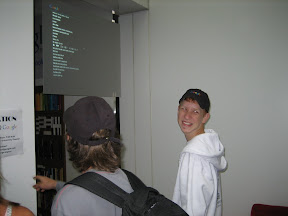
Patrick is a junior at Hopkins School in New Haven, CT. He finished several tasks, often swooping in to get the job done after another student bailed. He submitted fixes to Totem and ported baobab from gnome-vfs to gio, in addition to documentation and GTK+ performance tasks. I had a great time meeting him and his parents on Friday. I'm always encouraged to meet teenagers who actually *enjoy* math, and find opportunities to learn about software development. Patrick is going to be a counselor at a local computer camp this summer, brainwashing^W teaching teens the ways of code and circuit. We had a blast in the lobbies at each Google building, watching on a screen as the world's search queries scrolled by.

Mono's Grand Prize Winner: Dan Abramov

Dan is from St. Petersburg, Russia, and came to the ceremony with his mother (who had an awesome camera, I hope I get to see some of her photos from the trip). He's a largely self-taught 16 year old dynamo. He made some nice contributions to Mono, including Gendarme analysis rules and MonoDevelop addins and documentation. One of my favorite moments of this trip is when I was asking Dan about his future plans, did he intend to go to university in Russia, pursue Computer Science, etc. He told me that although he felt confident programming in managed languages like C#, he wanted to understand more about the low-level details. He asked me if I had read Joel Spolsky's article on "leaky abstractions", and described how sometimes .NET/Mono programming could be like that. I could only laugh with joy that this guy was already reading (and understanding) Joel.
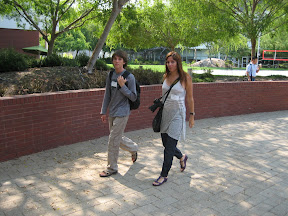
Daniel and his mother
I think it's pretty clear that these students have a huge head-start in computer science. Everybody was interested and excited about open source software. I got a lot of questions about what it's like to work on open source software all day at Novell. Being there, it really felt like I was looking at the next generation of open source leaders. I can only hope they stick with it instead of going down the boring path of being a doctor or a lawyer or something. ;-)

Thank you Google for encouraging these kids, and providing incentives like GHOP and Summer of Code to keep them in our world.

The Visit

It was pretty cool to meet the mentor representatives from other open source projects, some of whom were actually Google employees. Friday was a busy day, what with touring the Google campus, having the actual award ceremony, being interviewed for YouTube (eep), and stuffing my face. We saw presentations about App Engine (by Guido van Rossum), Android (Romain Guy), Google infrastructure (Jeff Dean), and testing at Google (Bharat Mediratta and Mike Bland).

My favorite talk by far was the testing one. Bharat and Mike are among the better pair presenters I've seen, so it was a joy just to watch them. But the subject matter is dear to my heart. At my last company I was often frustrated with how difficult it was to proliferate best practices (specifically TDD) even within a single team. I was fascinated to hear how these guys just decided to fix the testing problem at Google, guerrilla-style. They introduced the awesome Testing on the Toilet newsletter, devised testing training and certification programs for projects and employees, and introduced "test mercenaries" to spread skills where needed by hopping from project to project, staying only a few months with each. Ingraining these practices in a company's culture is a singularly difficult problem. Their example is inspiring, though of course it requires constant ongoing work, and it might be difficult to convince any company to invest such significant resources into a never-ending program like that. I've been following the Testing on the Toilet blog for awhile, but meeting these guys was truly invigorating. I wish there had been time to chat them up afterwards!

The Rest

Over the weekend, Ellery and I visited our old stomping grounds at San Francisco State University, Stonestown Borders, and West Portal. We had a fun dinner with Liz and Bernat at Mozzarella Di Bufala. It was nice; I really do miss my friends sometimes. :-) Later we visited some family in the East Bay.

Ellery is Queen of the Campus
The rest of my photos can be seen on my picasaweb. By the way, Lazyweb, do you know how to tag all photos in an album at once?

Wednesday, June 25, 2008

Recent Hacks: irc2wiki.pl and xchat-nick-pidgin-status.py

The Mono a11y team has weekly iteration meetings in IRC, and we post the logs to the Mono wiki. Our version of MediaWiki doesn't automatically prettify IRC logs, so for awhile I was using Jamie Zawinski's irc2html.pl to create HTML tables. Today I hacked it up to produce MediaWiki tables instead. I call it irc2wiki.pl. Fixes welcome (or better suggestions).

Also, I now live on IRC. Some people prefer to get me through IM, so I always have Pidgin running, but my online presence is mostly reflected in my IRC nick. I'm forgetful, so I kept noticing that I was "available" in Pidgin even though my IRC nick was "sandy|lunch", or that when I changed my nick from "sandy|brb" to "sandy" my Pidgin status would stay the same. I decided to automate that shit. Based on a bunch of useful code from Arstechnica's Ryan Paul, I present to you my first xchat plugin, xchat-nick-pidgin-status.py:


#!/usr/bin/env python

# Sets Pidgin status from XChat nick, assuming you use a style like:
# mynick => Available (status "Workin")
# mynick|busy => Away (status "busy")
# Hobbled together by Sandy Armstrong from code
# written by Ryan Paul (segphault) of Ars Technica:
# http://arstechnica.com/reviews/apps/pidgin-2-0.ars/4
# http://arstechnica.com/journals/linux.ars/2007/08/29/send-twitter-updates-from-xchat-using-python

import xchat, dbus

# Describe the plug-in metadata for XChat
__module_name__ = "Pidgin Status Plug-in"
__module_version__ = "1.0"
__module_description__ = "Set Pidgin status according to XChat nick"

# Specify status ID values
STATUS_AVAILABLE = 2
STATUS_AWAY = 5


def nick(words, word_eol, userdata):
# Get new nick
if len(words) < 2:
return None
new_nick = words[1]

# Check for status
pipe_index = new_nick.find("|")
if pipe_index > 0 and pipe_index < len(new_nick):
message = new_nick[pipe_index + 1:]
# set away with status message
set_status("", STATUS_AWAY, message)
else:
# set available
set_status("", STATUS_AVAILABLE, "Workin")


def set_status(name, kind, message):
# Create a new saved status with the specified name and kind
status = purple.PurpleSavedstatusNew(name, kind)
# Associate the specified availability message with the new saved status
purple.PurpleSavedstatusSetMessage(status, message)
# Activate the new saved status
purple.PurpleSavedstatusActivate(status)


# Initiate a connection to the Session Bus
bus = dbus.SessionBus()

# Associate Pidgin's D-Bus interface with Python objects
obj = bus.get_object(
"im.pidgin.purple.PurpleService", "/im/pidgin/purple/PurpleObject")
purple = dbus.Interface(obj, "im.pidgin.purple.PurpleInterface")


# Associate the nick function with the /nick command in XChat
xchat.hook_command("nick", nick)

Tuesday, June 24, 2008

Tasque 0.1.6 Released

Yesterday I released Tasque 0.1.6 to a legion of hungry Linux users. I can't believe it's been three months since 0.1.5 was released! You can expect to see 0.1.7 a lot quicker, especially because there are some good patches in bugzilla that just need a bit of review.

As you might expect, Tasque 0.1.6 is our best release yet. There's a new task entry widget at the top of the main window, and due dates are parsed right out of the task text. Plus, there are the usual handful of bug fixes, including a few crashers.

Give it a try, and let us know what you think!


Sunday, June 8, 2008

Dear LazyWeb: TiVo, MythTV, Decisions

So we have a TV in the bedroom now. We generally watch TV in the living room, where we have an old Series 2 TiVo that does the job. Now, in the bedroom, we miss the essential TiVo features: accessing recorded shows and pausing/rewinding/fastforwarding live TV.

As far as I can tell, these are my options:
  1. Buy a new TiVo + subscription for the bedroom.
  2. Set up a MythTV box in the bedroom that can get content from the other TiVo using tivodecode.
  3. Buy a MediaMVP or AppleTV and somehow rig it up with tivodecode so I can access content from the other TiVo. This doesn't allow me to pause/rewind/fastforward live TV, though.
Buying a new TiVo has the following costs:
  • New TiVo box: $99
  • New TiVo wireless adapter: $59
  • New TiVo subscription: ~$6/mo
  • Total over one year: $230
Option 2 is setting up a complete MythTV backend+frontend and deploying it in the bedroom. Considering that I'd have to buy a complete PC with a TV tuner, and I'd want it to be attractive and quiet, this would probably be $500-$800. Alternatively I could set up an ugly backend and an attractive frontend, but I doubt that would be any cheaper. This would allow me to have complete TiVo functionality (and more) in the bedroom, and would prevent me from falling further into the TiVo lock-in trap. It's a very tempting solution, but I'm put off by the initial cost.

The Hauppage MediaMVP seems pretty cool. It's hackable, can be made into a MythTV frontend if I ever decide to go down that road, and is super-cheap at $150. The only problem is that I'd either have to use Windows to serve it content, or hack it with MediaMVP Media Center, which doesn't seem very easy to use.

I'm not sure if I can use an AppleTV on my standard def TV. Its only advantage over the MediaMVP is sheer processing power (and easy-to-use interface if I used the provided software). It costs $229.

I guess I have to decide if manipulating live TV in the bedroom is important to me. If not, I could get a MediaMVP or AppleTV and rig up something on the server side to pull content from my TiVo and prep it with tivodecode. This could later be expanded into a full MythTV setup when I feel ready to invest in backend hardware.

However, if pausing/rewinding/fastforwarding live TV is a must, then it seems the more efficient choice is to buy another TiVo.

So, LazyWeb...what should I do? Do you use MythTV? Any compelling reasons that I should invest in setting it up?